Sunday, 15 January 2017

The Harsh Realities of My Return to Soroti

It was the middle of March last year, when I set foot in Soroti for the final time before heading back to Canada. In the months that I spent working in Kampala, I had the pleasure of travelling to this district on several occasions with my then-colleagues. These trips played an integral role not only in the amount I fell in love with Uganda, but also my desire to return and essentially settle here. So, having the chance to return this past week – although only briefly – was pretty incredible!

Our journey to Soroti started just before 7AM.  The sun was just peaking its weary head from the previous night’s rest*. Along the three/three-and-a-half-hour drive from Jinja to Soroti I happily took in the sights, which included endless landscapes, farmland, and just overall breath-taking views. That drive rarely disappoints. However, there was something different about this one.
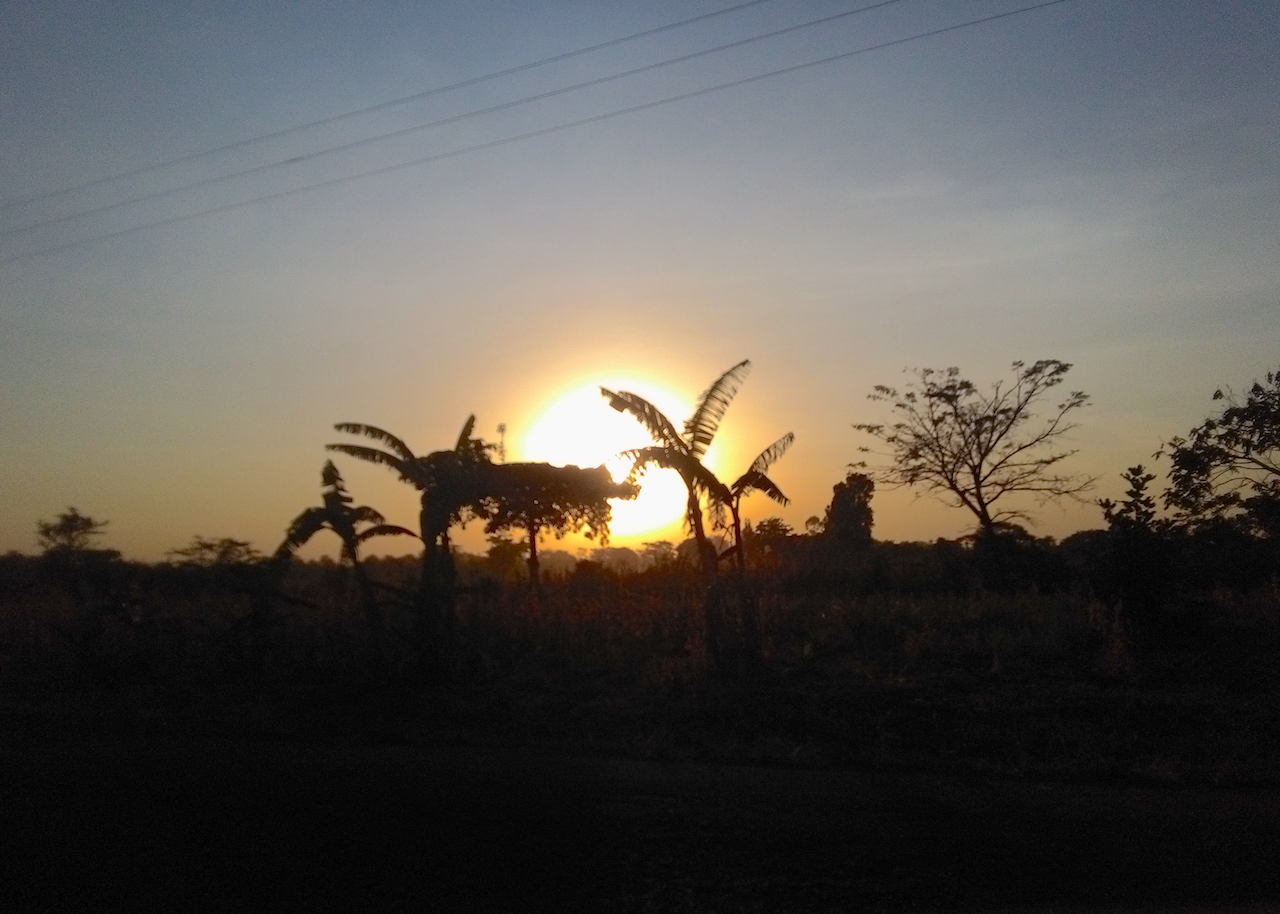
Perfect sunrise! One of the many “terrible” things about life in Uganda! 

I’ve been pretty vocal over the last few months about the failing rainy season, the lack of rain in general, and therefore the emerging challenges related to food production and harvest. Only a few months ago, I watched, soberingly, as my neighbour pulled up her garden, because instead of the crop she had hoped to find, there was nothing but lifeless vegetation. And although rain has come from time to time, it has been sporadic at best, and without the power to enable much to grow**.

The drive to Soroti and back – particularly the more up-country we found ourselves – made the impacts of these lacking rains undeniably apparent. My heart began to sink the closer we got to Soroti, because it became even more evident just how dry things had become. And once we arrived in town, I was shocked to find winds carrying large amounts of dust, in a similar way I would have witnessed blowing snow following a recent storm. But the reality became even more obvious, once I realized that this same week last year, I was also in Soroti, and it was much, much different. Yes, things were a bit dry, but there was still life flowing pretty much wherever you looked.

Dry conditions just outside of Soroti on the way up. 
I was told that the last real rains took place seven months ago***. When I was last in Soroti, the first rains of the year had just begun. These rains can be so intense at times, that when it started part way through our meeting, we had to scurry to tear down everything, pack up and get out of the area quickly because there was a high likelihood that we would get stranded due to flooding. And, even though that was in March and not January, it’s still quite a drastic difference****, which only further proves that climate change, in this part of the world, is going to hit hard, and fast. I see the impacts of this reality every day, although usually in smaller ways – through conversations with farmers and market vendors that I interact with on a weekly basis. The challenges that this country – and much of this continent – are going to be facing, isn’t what most of us in the West could ever imagine. In fact, this is really the area of the world climate deniers need to visit… provided they’d actually care about an area outside of their own. In other words, my heart is a bit heavier than I’d like.

This photo was taken in January 2016. Although it’s not along the roadside, it
is still clear to see that there is a pretty big difference between this year and last!
Views from the highway just outside of Soroti... she’s lookin’ pretty dry!

But, the trip wasn’t all doom and gloom. In fact, it was actually quite enjoyable, despite this sobering reality. I was able to catch up with an old friend, complete a number of tasks (which was the actual purpose of this trip), and even meet up with my former colleagues who also happened to be in town at the same time! There may have also been a little tea-test, which although the below video states otherwise, was actually a winner!

Happy to be back in familiar territory! Behind me is Soroti Rock. 
Artha is a tea connoisseur. His approval basically makes or breaks how he feels about a place. 
This only one of the many weird and wonderful things that defines this epically quirky dude!

Regardless of how much things have physically changed, Soroti still holds a good chunk of my heart. However, I feel equal parts fortunate and frightened when I allow myself to fully take in what is happening around me. Seeing these current challenges only drives me further to work hard at meeting my goals, because I know things can turn around with enough effort. I’m not suggesting that my tiny contributions will solve the issues of climate change in this area, but that I can at least provide a bit of support to those who are already struggling to face these challenges. It’s these current conditions that make my work even more relevant and necessary – again, not that I have all the answers, but that I’m at least trying to help those with an equal determination, to at least mitigate some of these struggles.

-the Orange Canadian

*Yes, I am aware that the sun doesn’t actually rest…
**The results of this were noticed even more, during my most recent visit to the market. My choices were extremely limited – even tomatoes seemed to be in short supply. This was not my experience during my previous stay in Uganda. Yet, prices don’t seem to be reflecting this, which makes me question whether or not the full impacts of this dry rainy season are truly understood.
***Which is about when the first rainy season of the year would have ended…

****Not only physical differences in terms of vegetation health, but even temperature itself. When I was in this district last January, the highest temperature was 34°C (93°F). This time around it was 43°C (109°F), which, for the record, is the hottest temperature I’ve ever been exposed to… and still, somehow managed not to get a sunburn!

Wednesday, 11 January 2017

What’s the deal with fish kills?

Part-two of my exciting* investigation into ocean health and its relation to climate change – a discussion on the recently emerging concern over fish kills, or mass fish deaths, that have been occurring at home and around the world! To tackle this topic a general background of the impact on climate change on fish will take place, followed by a more in-depth look at what seems like a newly emerging trend of something called a fish kill.

In the previous post about the impact of climate change on the oceans, it was discussed that fish migrations are one of the biggest concerns. This was due to rising water levels and temperatures, changes in circulation cells and current patterns, as well as ocean acidification leading to a lack of nutrients for fish species to feed on. But related specifically to fish populations, there is a bit more to it than simply understanding ocean health, itself. Of course, all the aspects noted in the previous post have impacts on the habitats of fish species, which was discussed briefly. This first section will look at two much broader issues, that do impact aquatic ecosystems: ocean acidification and rising water temperatures.

The rise in acidity prevents species such as shellfish and coral to produce their shells. But it’s not just the species that appeal to humans – either visually or deliciously – that are impacted directly by this process. Ever hear of a thing called zooplankton? Well, this is one of the main staples for a good chunk of aquatic species. Zooplankton, like the above mentioned species, also have shells, which are prevented from developing through the process of acidification. If zooplankton cannot form, what will the fish that rely on it as a source of nourishment use to supplement it? In other words, ocean acidification doesn’t just hurt our own food sources, but that of the aquatic species we like to eat!

Rising water temperatures are linked to ocean acidification, meaning this, too, impacts the food sources for many fish species. But, this aspect of ocean-related climate change actually impacts fish in another way. Fish require specific temperatures in order to maintain healthy, happy lives. When water temperature fluctuates – one way or another – it can affect their ability to metabolise the foods they have consumed. When this ability has been compromised, it leads to a species’ inability to grow to full capacity, reproduce, and therefore continue to repopulate – thus completely altering its lifecycle. This, obviously, leads to a variety of challenges, both related to the fish populations themselves, but also, to us human-folk who rely heavily on many of these affected species as a source of food. This problem, of course, is further exacerbated as we continue to participate in over-fishing practices, which lead to additional decreases of the aquatic populations.  Which leads me to my next point/topic: fish kills.

The discussion of fish kills became a widely discussed subject in Nova Scotia in recent months. Some of you may recognize this article, or one of several-like ones. You may have even seen a variety of Facebook posts including pictures of shorelines covered with various aquatic species. And, yes, this does appear to look quite alarming… but is it really?


The basis of the above CBC article and subsequent posts on social media put into question a recently placed tidal turbine in the Bay of Fundy, as a possible source of these washed up fishies. The article did debunk this suggestion, and knowing the extent of research that has been conducted over the years related to this topic, I was sceptical of these allegations, myself. Any large scale project, such as this, would have been subject to fairly substantial environmental impact assessments (EIA) – even despite Harper’s rewrite of EIA law and processes in Canada a few years back. But, given that there were 4 reported cases of fish kills between the end of November and throughout the month of December, it is understandable to think there might be something related happening in Nova Scotia’s waters.

So, to get started on the topic of fish kills, perhaps a brief definition is in order!

Also known as fish die-offs, a fish kill relates to the occurrence of mass, or highly noticeable, fish population deaths. They are usually made noticeable when the group of dead fish wash up on shore, creating a rather alarming sight. While they can be caused by human-related activity, most cases of fish kills happen as part of some natural process. These causes include:
  • Algae blooms and red tides
  • Biological decay
  • Diseases and parasites
  • Droughts and overstocking
  • Oxygen depletion
  • Pollution and Eutrophication
  • Toxins
  • Underwater explosions
  • Water temperature

But, for the purposes of this post, I will be focusing on oxygen depletion, water temperature and toxins.

Lack of oxygen has been frequently noted as the number one reason for the occurrence of fish kills. Like us, fish also require oxygen in order to breathe – although their method of accessing it is a bit different from ours! While you or I would get oxygen through the natural processes above water, fish retrieve it through dissolved oxygen found within the water, itself. When fish aren’t able to gain enough oxygen, just like we would, they begin to struggle to live, and eventually, if that isn’t corrected, will die.

Now, there is a pretty substantial link between oxygen levels and water temperature rise. You see, cooler waters hold greater amounts of oxygen. So, as water temperature rises, the amount of oxygen found within a particular body of water will begin to drop. However, fish kills can also occur when cooler temperatures happen rapidly, because, let’s face it, any drastic change in temperature affects most living things. By this, I ask that you think about how extreme temperature changes affect us, as humans, with an ability to bundle up or peel down. Fish don’t have this luxury; therefore, they are more directly affected by these fluctuations. These warmer temperatures can also breed algae blooms, parasites, and other forms of aquatic disease, all of which have a direct impact on fish populations.

Finally, it is important to touch on the topic of toxins**. This, of course, is a much less natural occurrence, and is something that we actually have some degree of control over changing. It isn’t overly difficult to understand how toxins can negatively affect not only fish species, but the ecosystems in which they inhabit. Depending on the size of the body of water contaminated, the outcomes of the introduction of a toxin can have varying results. In other words, contaminating an entire ocean requires far more toxins than, say a small lake. But, toxins can come in several forms, some of which we may not think of. Oil spills are usually what comes to our minds in these cases, but are only one of many ways that toxins can enter a body of water. These situations can also occur through agricultural run-off, improper disposal of chemicals or hazardous waste, and sewage, to name a few.

So, while the appearance of fish kills can certainly provide us with a sense of alarm, these are actually natural processes. However, there have been few reports of total population losses as a result of these occurrences. This doesn’t mean we shouldn’t keep an eye on things, but rather that when it does happen we shouldn’t be quick to blame things we might feel are the obvious causes. Either way, there are some correlations between human activity and fish kills. Climate change is also certainly having an impact of fish species, making it all the more important to make conscious efforts related to how we are interacting with the natural world – both as individuals and a wider species.

-the Orange Canadian

*Perhaps it’s only exciting to me…

**Say that 10x fast!

Tuesday, 10 January 2017

What Climate Change Means for the Oceans

I’m going to warn you – the next few posts are likely to surround the topic of climate change, as a partial continuation of the previous one, but also because a pretty big topic has recently been brought to my attention, and I wanted to explore it a bit further. So, Part One of this “two-part series” will focus on how the oceans are being impacted by climate change.

***

Each year between 1970 and 2010, the temperature of the shallowest waters of the ocean increased by 0.1°C. This may not seem like a lot, until you look at that accumulatively. There’s 40 years recorded there, at 0.1°C per year, which is 4°C*. Again, 4°C likely doesn’t seem all that significant, but the reality is that this actually has quite negative implications for the aquatic life found within these waters, as well as the fact that overall wellbeing of the oceans themselves are highly compromised. How exactly? Well, in a number of ways – with some being more obvious than others, of course.

To start, there’s this whole thing around sea level rise. With mass ice melt happening around the world – particularly the frightening acceleration of the Greenland Ice Sheet finding its way into the ocean in liquid form – water levels are beginning to rise. This mostly impacts those living in coastal regions, such as my home province of Nova Scotia. But, as a bonus to these rising sea levels, the instances of drowning wetlands are also becoming a common occurrence. This means that coastal areas – wetlands – aren’t able to keep up with the rising water levels of the ocean, creating these neighbouring coastal areas to be submerged under water. Again, this is important because wetlands house a number of important species and ecosystems that are part of the already delicate balance of the natural world. So, seeing these two related impacts of climate change, happening before our eyes, is kind of important and alarming!

Okay, so you may be asking what’s the problem with a little extra water floating around? I’ll tell you what – it has a little something to do with a thing called the jet stream and ocean currents!

The currents that occur in the oceans are the result of a mixture of the earth’s latitudes** and varying water temperatures. What this means is that the warm air near the equator sucks in cooler air, which generates what is known as circulation cells. This is why it’s colder in the poles than at the equator. But, these circulation cells also bring about wind.

Wind is important for the movement and temperature control of the water. But, the warming of the oceans directly impacts the capacity of these wind patterns, which leads to the warming of the oceans’ waters, and as a result melts the ice that currently forms glaciers. And with this melt comes, the dilution of the ocean water, which leads to an inability for that cooler water to be pushed below, thus disabling the regulation process of ocean temperatures. This also leads to the creation of more extreme weather patterns***.

This destabilization of wind patterns also hinders the ocean currents from continuing another important function – providing nutrients to aquatic life particularly near the equator. If this provision of nutrients were to cease, well, say bye-bye to the ocean food chain, the many ecosystems within these vast areas of the planet, as well as an even more difficult process for the oceans to absorb carbon (this will be discussed in a second – stay with me!), leading to further – you guessed it – global warming!

In addition to these warming ocean temperatures is the occurrence of fish migration (which will somewhat be the basis of Part Two). Basically, as a result of the warming waters, fish species are beginning to migrate outside of their regular territories. In recent studies, there has been indisputable evidence to show that many fish species have been drawn towards the poles as a result of warmer water temperatures.

And finally, we should probably have a discussion about ocean acidification. One of the incredible functions of the oceans is its ability to absorb carbon dioxide – especially the nasty amounts we, human-folk, produce. It is believed the ocean can absorb around 30% of what we produce, although this has been challenged significantly in recent history, given the amounts created by humans each year. What does this mean? Well, the pH level of the ocean is beginning to drop, which has increased the acidity of the water.

Part of this acidification involves coral bleaching. The term coral bleaching refers to the physical colour transformation that takes place when the nutrients, and essentially, life of, coral ceases. We all associate coral, and more broadly coral reefs as being full of a variety of colours and movement. But, when coral dies, it turns a sedentary, white colour, devoid of life. The rise in water temperature has a major part in this transformation, as does pollution. And while this may not seem like a big deal, coral is an essential part of ocean wellbeing because it’s home to a lot of food sources not only for us humans, but a number forms of aquatic life.

Furthermore, this acidification leads to another complication for ocean wellbeing - the reduction of sulfur moving from the ocean into the atmosphere. The result of this inhibited process, is that it essentially prevents the reflection of solar radiation between earth and the atmosphere (and beyond), which is one of the ways this warming process we hear so much about takes place.   

But what does this all mean for those of us living outside of the oceans? Well, a lot, actually. When you think of just how significant the ocean is in terms of the make-up of the planet, we know it makes up approximately 70% of the earth’s surface. These oceans aren’t just there for us to access fish, or to enjoy a casual day out on the water – they actually directly impact climate and weather patterns, as was noted above. The scary bit about these impacts to climate and weather in the oceans, is that they also directly influence these same patterns in-land. Remember those droughts that seemed to affect most of the world this past summer? Don’t think this isn’t related to what’s happening in the oceans. The intensity of recent hurricanes, cyclones, and the lack of heavily dependent upon monsoons in several areas (such as parts of sub-Saharan Africa) are also a part of all this. They can impact everything from how food is produced (or not), to loss of coastal land, and even damage to homes and other livelihood-related impacts. So, to say what happens in the oceans stay in the oceans is on massive misunderstanding!

Lawrencetown Beach, Nova Scotia - aka one of my favourite places on earth
The realities of our changing climate can be found in all corners of the earth, if only we open our eyes wide enough to full accept what is happening around us. As someone who grew up near the Atlantic Ocean, maintain it as a multi-functioning ecosystem is something I need to pay more attention to. I also really hope to return home one day (and hopefully throughout the years to show it off too many friends made along the way) to eat all the fish in said ocean, so please, for my own selfish sake, keep my ocean happy and healthy!

-the Orange Canadian

*That 4°C, by the way, is equivalent to 7.2°F.
**Meaning, where in the world, latitudinally, these waters are located, as in the difference between the equator and the poles, and anywhere in between!
***Hellllloooooo Environmental History, circa 2011!

Saturday, 7 January 2017

A Delayed Reflection of DiCaprio’s Before the Flood

Dear Leo,

I was confused to find you heading a documentary on climate change, because, honestly, I was pretty certain you drowned at the end of your previous documentary, Titanic. But after spending the 90-ish minutes taking in your message, I was actually quiet thankful you had miraculously survived, after all.

Recently, while sitting on a virtual panel with soon-to-be-graduating ESST* students at Acadia University, I was asked how do you discuss environmental issues without making everyone depressed? My answer was, of course, I left Canada and moved to Uganda where there is a high degree of discussion and conversation around the topic, because the impacts of climate change, global warming, global dimming, or whatever you want to call it, are felt here on a daily basis. But that’s not the point I’m trying to make… well…

The point is, in good ‘ol We the West where we remember to bring our reusable grocery bags with us to the store and then proceed to pat ourselves on the back for the next 35 minutes, we’re a little bit in full blown denial. And this is kind of what I believe you, my dear friend, United Nations Messenger of Peace on Climate Change, and teen heartthrob/Academy Award winning (finally!) actor, Leonardo DiCaprio, are trying to get across in your recent collaboration with National Geographic – a documentary entitled Before the Flood.


During your journey to become one of the most recognizable “non-credible” voices for the fight against climate change, you have also come up against a lot of criticism. This, as you’ve pointed out, is because you don’t have a formal education on the matter**. But I think the fact that you didn’t grow up surrounded by nature gives you even more credibility, because it essentially makes you an outsider. What I mean by this, is that you didn’t grow up with an ingrained value for nature, it came to you over time, through your own initiative, and has shaped the message you are trying to impart on the world today. It is, really, people like you, that we are needing to convert more than any others – because it’s those who have no relationship with nature that are usually the quickest to dismiss the direction we’re headed.

I will be honest; I have watched this film a couple of times now. The first time, I jotted down some fairly petty critiques and facts that I intended to follow up on (but even as I type have yet to actually do) – the most memorable being my disappointment that you could lead a discussion of this sort while standing next to a sir wearing a Canada Goose jacket in the Baffin Islands, and take him seriously. I mean, come on – how was that possible, what with your message of the tar sands, rainforest destruction, and a number of other related issues?!

Anyway, I took another glance at the film – once again, notebook in hand – and tried to really sort out how I felt about it. Here’s what I’ve come up with.

This is actually nothing more than a rehash of Al Gore’s An Inconvenient Truth, except its far more engaging, visually appealing, uses basic terminology and as a result is easily digestible to the average North American. And for me, this has been one of the biggest problems with the discussions of climate change, or environmental issues on the whole. They tend to be geared to scientific audiences already familiar with the lingo, and therefore the average working-class individual is lost before they’ve even begun.

But however informative and thought provoking this doc may have been, I fear the conversation will start and stop within the confines of this film’s popularity. I mean, I’m delayed in addressing it, and I think we can both agree the conversation has died down dramatically, already. This isn’t because the information wasn’t convincing, or the visual evidence you tried to highlight didn’t show the real impacts of climatic change currently happening in the world, but rather, we have yet to truly experience these effects in the West. In fact, many of the impacts that have already been felt have been considered fairly positive – less snow in the winters, better temperatures for growing seasons (such as the recently booming wine industry in my home province of Nova Scotia), for example. But, if North Americans in particular lived with the conditions already happening in places such as my current home of Uganda, I think the conversation would be much, much different. This doesn’t make North Americans bad, careless people, it just makes them the exact product of Western culture that has put us in this mess in the first place – act now, think later, because it will be someone else’s mess to clean up…

Furthermore, there was a comment related to the 2015 Paris Agreement on Climate Change, and how there was nothing in place to enforce the outcomes of these discussions. You asked how likely it will be for the signatory countries to follow through with the implementation of the agreements made. And to that, sadly, I say minimal, if at all. This speaks more to the ineffectiveness of the UN, rather than any country’s willingness to act (although that leaves much to be desired, as well). But it is also reflective of a pattern we have seen time and time again, where a lack of action is demonstrated throughout recent (global) enviro-political history.

Let’s take Kyoto, for example (and yes, admittedly, this might be a bad example). When then-Canadian Prime Minister Stephen Harper backed out of the Kyoto Protocol, he received a lot of negative feedback and press. I, on the other hand, commended him for this, not because I wanted him to further deny the very realities of our world, but because he knew it was not possible to reach those targets, and was at least honest about his lacking desire to follow through. And believe me, I know how bad that sounds, all around! But again, unlike many other leaders who signed the declaration and then turned the other way, he actually acknowledged that he just wasn’t going to do anything about it.

The fact of the matter is, climate change (or whatever the latest buzz word is to describe this occurrence), although a global issue, needs to focus on a series of locally relevant actions that are interlinked from one country to the next – not this painting everyone with the same brush nonsense that we’ve been witnessing with past UN initiatives like the MDGs. THAT’S the only way we will tackle this crisis! Not by unfairly assigning tasks to countries that neither caused the issue in the first place, nor have the means to achieve the targets that have arbitrarily been set for them, but by focusing on the meaningful actions that are relevant to their own fight, within the greater context of the global crisis. And it’s for this same reason that I resent your statement that small steps are no longer enough. In fact, this remains entirely relevant! These “small steps” are the beginning for so many to enter into the realm of environmental consciousness, which leads to environmental activism and/or justice. I can say this with great confidence, because, although I grew up playing in the woods, using nature to spark my imagination, I was just like the vast majority of North Americans – completely in denial. It took several small steps to bring me to where I am today, both geographically, but also intellectually, compassionately, and ethically. Yet despite this, I’m still not perfect, and I, too, need to be reminded. So please, do not be so quick to dismiss this entry point.

But after all is said and done, I don’t have the answers for how to make the deniers or unshakables begin to wake up and act – even if slowly at first. I mean, after all, I’ve basically left Western culture, because I find it frustrating at the best of times. But this isn’t to suggest it’s a lost hope, and I truly think attempts such as your most recent one, can help to change mindsets, actions, etc. Maybe it won’t spark a global movement, but maybe it will motivate someone to take the first step towards environmental awareness, who will, in turn, influence someone else’s first steps. After all, that’s what it’s really all about, is it not? So, I do commend you on this initiative, but I also ask that you help search for alternative means to convey these urgent messages to those who presently have not or refuse to be converted.

This fight it is, without a doubt, a much bigger one than we realize. But as I’ve already said, it must involve many local steps, not just one giant global one. We need everyone on board if we’re to make things better. So, please, keep your fight going, with energy, positivity, and just the right amount of humility so that you don’t come off as an overly preachy celebrity*** who thinks his word is all that there is.

All the best,

-the Orange Canadian

*That stands for Environmental and Sustainability Studies
**To be fair, I do have a formal education on the matter, and I’m also probably not the best voice for it either!
*** *cough* Bono *cough*

Wednesday, 4 January 2017

Emphasising the ‘later’ in Purolator: A Tale of Christmas Heartbreak

Allow me to tell you a story. It goes a little something like this…

Once upon a time there was an Orange Canadian who lived in the far distant land of Africa, in the township of Uganda, which is found on the eastern part of the country (it’s a BIG country!). It was nearing that festive time of Christmas* and her family wanted to send her a few things that would make her feel not so far away.

So, after compiling a list, the family gathered together, placed the items in a box, and shipped it off in hopes that it would arrive in time for Christmas. In fact – it was sent with the ‘Purolator promise’ that it would arrive a week before the big day, meaning a 3-day delivery turn around.

She, along with her brother, eagerly followed the package’s journey each day with endless anticipation. From Canada, throughout the US, to Germany onto Dubai. And then – poof – it disappeared.

A few days later (meaning the week after the package’s departure from Canada), she received a phone call out of the blue from a courier company representing the Canadian service provider (*cough* Purolator/UPS *cough*). They informed her that her package had arrived, and would be available for delivery pending the standard payment of a customs tax, but also a not-so-standard delivery fee (that was to be paid whether it was delivered or she made the journey into Kampala to pick it up herself!).

In the final days leading up to Christmas, she spent a number of hours on the phone. Her brother also spent some time on the phone. And yet, the only thing that seemed to change was the ransom rate designated by the local courier service, ranging from a package processing fee, to a delivery fee, to an incorrectly entered package contents claim.

With no Christmas tree in sight, she fashioned herself a make shift tree out of the excessive amounts of toilet paper that seemed to be at her disposal, in hopes of a Christmas miracle. But it did not happen. She awoke Christmas morning to find no more than a toilet paper tree with nothing under its flimsy and lifeless “branches.” And the little Orange Canadian was left feeling sad and devoid of any Christmas spirit.

The end.

This isn’t the part of the infomercial when the calm lady’s voice chimes in to say that it looked “really real, didn’t it?” No folks, this is a real-life happenstance.

Yesterday (midway through week 3, post-arrival), I made my way into Kampala in order to retrieve the package in question myself. This, after numerous phone calls (a number of which went unanswered or were just never returned), and several failed delivery attempts. And, by “failed delivery attempts” I mean, I was told my package would be out for delivery on a specific day, and then that day came and went and no delivery took place**. To say this was an incredibly frustrating and far more complicated process than it should have been would be an understatement. But it didn’t end there…

One would think going to the office to pick up a package that the delivery company indicated they were in possession of would be a relatively simple task. But, it was in this instance that I fully understood why there was so much miscommunication and disorganization.

When I arrived at the courier’s office (approximately 20-30 minutes after I had spoken with a staff member who was following up, and to whom I informed I’d be arriving to the office shortly), I was told I would have to either come back another day, or wait an hour or so, because the entire staff had just gone to lunch. No one seemed bothered by the fact that I had just travelled over two hours to come get the package, and that I had a further two plus hours ahead of me to get back home, or that I’d been given the OK to come in at that time by one of their staff members not long before I had arrived. The only thing that made me feel good at this point, was knowing the other people waiting were also in a similar boat… 

Finally, I met one of the staff I had been dealing with over the past few weeks. And, with the help of my “girlish charms” and “highly persuasive skills,” (i.e. I Mom-yelled at them and told them to get it together!) I was eventually led to a completely different part of the building in which their office was located, where I waited once again, while they scrambled to find the package. In the end, I had the parcel in my hands after close to 45 minutes had passed.

Check out the beautiful wrapping job! 
And so, a week and three days after Christmas, Santa finally arrived in Jinja, leading to the completion of this visual evidence of how it all went down – a mockumentary, if you will.


The good news is, this company only deals with Purolator/UPS, so if any of you lovely folks ever feel like sending something to Uganda, use FedEx or DHL, because I’ve been told when they say door-to-door service (i.e. from Wolfville to Jinja), it actually goes from Point A to Point B as indicated on the weigh-bill, and not just as far as the capitol city and then held at ransom for several weeks until you eventually go pick it up yourself***!

The other good news is, I received four things of dental floss within the contents of this package, which brought about so much excitement it could only mean one thing: I’m definitely an adult now!

But in all seriousness, I returned home (sporting my first sunburn of the year, and actually the first since returning back to Uganda in September!), threw on Coldplay’s Christmas Lights (because it’s the only Christmas song I have on my laptop, and quite frankly the only one I actually like!), and quietly opened each item.

 My toilet paper Christmas Tree; The care package stash, in which all four packs of dental floss in plain view! 

Two of the wrapped gifts were a colouring book and coloured pencils. The colouring book 
is based off of the book I received last year for Christmas. And of course, it was immediately 
put to good use, being as my favourite spot in Halifax was included - Lawrencetown Beach!

Yes, this was frustrating. And yes, in the grand scheme of things this is small potatoes in comparison to some of the challenges facing the world today. But, I don’t like being taken advantage of or having my time wasted****.

However, with all that being said, I am so lucky to have a family back home who put enough thought and effort into sending me some of my favourite things to make that gap between here and there much smaller*****. I'm also thankful my brother shares my sense of humour, because we both enjoyed a few laughs during the course of this ordeal! But, next year – I’m paying a personal visit to a one Mr. San-T Clause at his all-inclusive North Pole resort. After all, it'll probably be cheaper!

-the Orange Canadian

*Hey… Why aren’t other holidays referred to as festive?!
**I lost two full days of work and a smattering of time here and there every other day in the weeks it took to receive my stuffs, which almost resulted in missing a crucial deadline, just to set those deliveries up. PLUS, another full day just to go pick it up!
***I also didn’t have to pay that excessive “delivery fee” that I had been told I would need to pay even if I came to get it myself! And what was this excessive rate, you ask? 95000 Ugandan Shillings (approximately $35 Canadian dollars). And how much did it cost me for a round trip journey to Kampala and back, plus local transportation? 25000 Ugandan Shillings (approximately $9 Canadian buck-a-roos). Don’t mess with the Orange Canadian - especially when there's Twizzlers, maple syrup and dental floss at stake!!
****And, yeah, I know, the real basis of my frustrations were founded on the massive privilege I have. Despite the disorganization of the office, I hardly think this process would have been so challenging if I weren’t a mzungu. And to be fair, this is really the only time I've been placed in this situation in all the time I've spent outside of Canada, so, I'm pretty lucky, I suppose. 
*****Also, I am now in possession of all the maple syrup products from my favourite maple syrup producer, Acadian Maple. So, don’t bother trying to look for any of their things back home!